Pick Up the Crown

There is a peculiar privilege afforded to powerful societies: the privilege of complexity. Their violence can remain violence, their organized crime can remain organized crime, their corruption can remain corruption, and their political failures can remain political failures without any one of those things permanently becoming the definition of the civilization itself.
Elsewhere, pathology has a way of becoming identity. Mexico becomes cartels. Colombia becomes cocaine. Haiti becomes poverty. Central America becomes migration and violence. The Caribbean becomes paradise when convenient and dysfunction when it is not.
This is not an argument for pretending that any of those problems do not exist. Mexico’s cartel violence is real, as are the political failures, inequalities, criminal economies and institutional weaknesses found across parts of Latin America and the Caribbean. The argument is about proportion: why some societies are permitted to contain contradiction while others are represented internationally by their worst contradiction. Reputation is not simply what a country is; it is also what the world has been taught to see when that country’s name is spoken.
That problem is much older than television, tourism campaigns or algorithms. Long before modern media could compress a country into an image, empires understood that power involved more than controlling territory. It also involved religion, language, archives, classifications and the authority to explain conquered people to the wider world.
The history of the Maya makes that problem impossible to ignore. Maya civilization produced monumental architecture, hieroglyphic writing, sophisticated mathematics and calendrical systems, astronomical knowledge, complex political societies, extensive trade networks and cities whose engineering still commands serious archaeological study. UNESCO’s documentation of Maya sites records advanced urbanism, water management, writing, mathematics, calendrical systems and astronomical observation across a civilization whose intellectual and material achievements cannot credibly be reconciled with older caricatures of Indigenous America as culturally primitive.
Nor should the Maya now be converted into the opposite caricature: a peaceful, flawless civilization destroyed by uniquely violent outsiders. Maya states fought wars, competed for political dominance, maintained social hierarchies and practiced forms of ritual violence and sacrifice. They were human societies possessing brilliance and brutality, innovation and inequality, political ambition and spiritual conviction. That complexity is precisely the point, because complexity is one of the privileges routinely granted to civilizations regarded as great.
Conquest profoundly changed whose records survived and who possessed the authority to interpret them.
In Yucatán in 1562, Franciscan Diego de Landa interrogated Maya people and participated in the destruction of Indigenous religious objects and books he regarded as idolatrous. He would later write an account of Maya life that became an important historical source, producing one of history’s more unsettling archival contradictions: a man associated with destroying Indigenous records subsequently became one of the figures through whose writing later generations attempted to understand the people who made them.
The question raised by that contradiction reaches far beyond the sixteenth century. What happens when somebody acquires the power not only to defeat you, but to describe you?
Religion belongs within this history, but precision matters. Christianity should not be reduced to a synonym for colonialism, any more than Indigenous religion should be romanticized simply because it was suppressed. What can be documented is that religious authority and the campaign against what colonial authorities classified as idolatry became instruments through which Indigenous practices, objects and knowledge were attacked. The issue is not faith itself; it is what happens when faith is joined to coercive political power and one civilization receives the authority to decide which parts of another civilization deserve to survive.
That authority has economic consequences long after conquest ends. A society whose architecture is treated as civilization, whose craftsmanship is treated as heritage and whose historic objects are treated as masterpieces accumulates cultural capital. A society whose equivalent achievements are predominantly encountered as ethnography, archaeological curiosity or the remains of a vanished world enters the modern imagination differently.
Europe understood the economics of cultural capital exceptionally well.
Consider Champagne. The word does not merely describe bubbles in wine. It identifies a place, production traditions, legally regulated methods, accumulated reputation and a protected geographical designation. Producers and institutions spent generations defending that relationship between product and provenance, and today the Champagne designation is protected through French, European and international legal mechanisms.
The genius is not that Europe invented heritage. Every civilization possesses heritage. The genius was learning how to organize heritage into institutions capable of protecting, reproducing and monetizing cultural value.
The same logic runs throughout luxury. A château is not simply an old building. An atelier is not simply a workshop. An archive is not simply a collection of old things. A regional technique can become protected know-how; a family history can become brand mythology; an old pattern can become a house code; a particular landscape can become provenance. Material, geography, history, craftsmanship and storytelling are assembled until the object contains something more valuable than the sum of its physical components.
Once you understand that mechanism, looking at the Americas becomes almost disorienting.
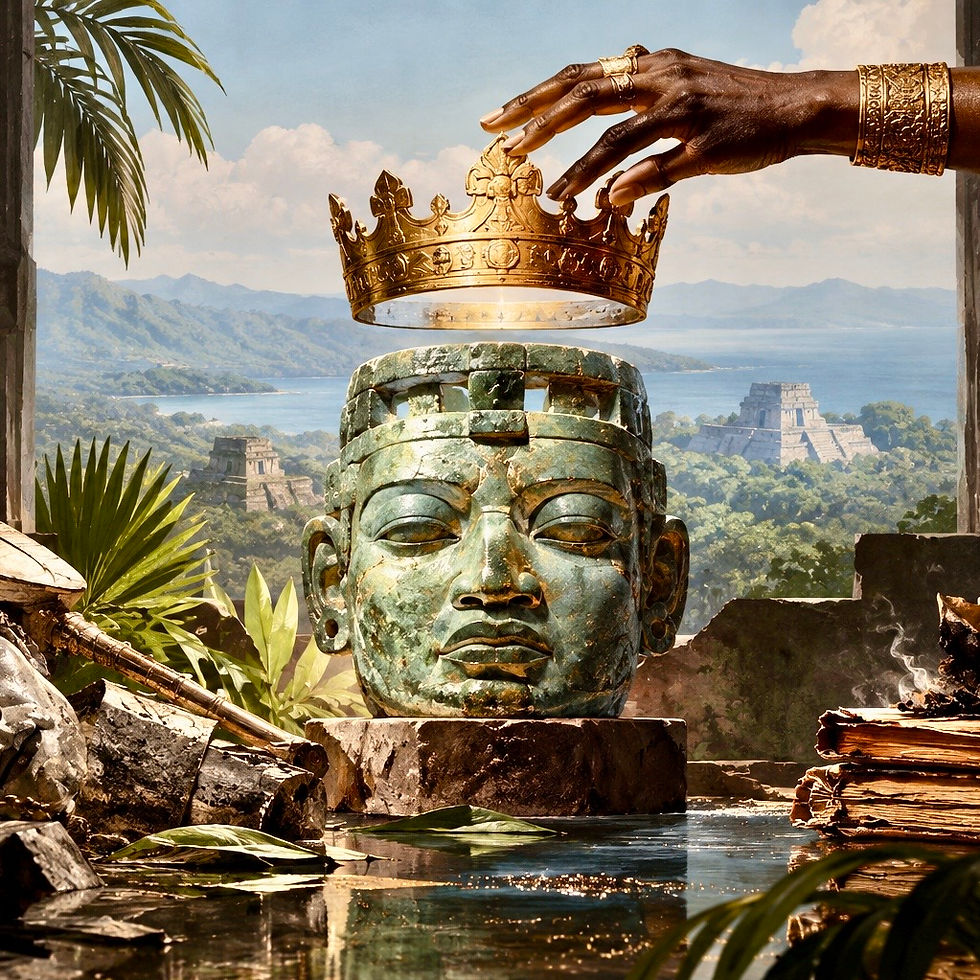
In Belize, the Maya site of Altun Ha produced one of the country’s most recognizable national treasures: the enormous carved jade representation of the Maya sun deity K’inich Ajaw commonly called the Jade Head. Belize’s National Institute of Culture and History describes it as the largest carved jade object recovered in Mesoamerica and situates Altun Ha within important coastal trade networks. The object embodies rarity, material knowledge, craftsmanship, iconography, political authority, trade and religious meaning, the very characteristics that elsewhere help construct what the modern world calls heritage.
Yet jade does not occur naturally in Belize. Its presence itself points outward, toward the networks connecting Maya communities across Mesoamerica. What sits before us, therefore, is not evidence of an isolated provincial culture but of exchange, specialization, value and movement across a much larger civilizational geography.
That matters because modern borders can distort the scale at which we understand the past. Belize, Guatemala, Mexico, Honduras and El Salvador are contemporary political states; Maya civilization cannot be neatly contained within those boundaries. The same is true elsewhere in the Americas, where modern republics sit upon landscapes whose cultural, commercial and political histories preceded them by centuries or millennia.
Teotihuacan offers another warning against small thinking. At its height, the city was among the largest urban centers in the ancient world, with monumental architecture, extensive planning, apartment compounds, religious complexes and economic networks whose influence traveled far beyond the Valley of Mexico. The Inca, farther south and centuries later, governed an enormous Andean political system connected through roads, administrative structures, agriculture adapted to difficult terrain and extraordinary stone construction. These societies differed enormously from one another, and collapsing Maya, Mexica, Teotihuacano, Inca and other civilizations into a generic Indigenous past would reproduce another kind of historical laziness. What they collectively demonstrate is something simpler: there was never an empty hemisphere waiting for history to arrive.
The Politics of Reputation
Colonial rule eventually ended across most of the Americas. The politics of description did not. Modern countries can be trapped inside reputational shorthand with extraordinary efficiency. Mexico’s global image can become inseparable from cartel violence. Colombia spent decades fighting an international identity constructed around cocaine. Haiti is routinely introduced through poverty, disaster and political instability. Venezuela is frequently encountered primarily through authoritarianism, migration and economic collapse. Entire countries become problems before they are permitted to become places.
Again, none of these conditions should be minimized. A journalism worthy of the region must be capable of examining homicide, corruption, democratic erosion, trafficking, inequality and state failure without flinching. Picking up the crown cannot mean polishing away the blood on it.
But perspective requires another question. Why does serious organized crime in a wealthy country generally become evidence about organized crime, while serious organized crime in a poorer country can become evidence about the country itself? The global narcotics economy makes the contradiction particularly visible. Cocaine production is concentrated geographically, but consumption, financing, money laundering, logistics and distribution cross borders and continents. Synthetic-drug production and consumption likewise implicate sophisticated economies and transnational networks. The United Nations’ drug reporting describes markets that are global rather than problems that can honestly be contained within the countries whose names become most closely associated with them.
There are major criminal organizations in Europe, North America and Asia. There are sophisticated fraud networks, trafficking operations, cybercriminal enterprises, illicit financial systems and organized violence inside some of the world’s wealthiest societies. Yet Paris remains Paris. New York remains New York. London remains London. Their criminality is treated as something occurring inside a civilization whose greater identity survives intact. That privilege, the privilege of remaining larger than your pathology, is itself a form of power.
When History Has Outside Hands
There is another complication that any serious discussion of the region must confront. Some of the instability for which Latin American countries have subsequently acquired reputational damage occurred within histories in which larger foreign powers were not merely spectators.
The record does not permit the simplistic conclusion that outsiders caused every failure. Domestic political actors possessed agency. Local elites made decisions. Militaries seized power. Governments mismanaged economies. Corruption developed internally as well as through international relationships. Organized criminal enterprises were built by people within the societies they damaged.
But neither does the documentary record permit pretending that external intervention was imaginary. In Guatemala, declassified United States records document the CIA’s role in Operation PBSUCCESS against the government of President Jacobo Árbenz in 1954. The operation involved support for Carlos Castillo Armas’s forces, propaganda, diplomatic pressure, efforts to influence Guatemalan military officers and CIA-contracted aerial operations before Árbenz resigned. The subsequent history of Guatemala belongs to Guatemalans, but any honest account of the country’s political trajectory has to accommodate the fact that a major external power deliberately intervened in it.
Chile presents its own complicated record. Declassified documentation records covert American funding for opposition parties, media and private-sector organizations during the Allende period and a broader policy of pressure against his government. The available documentary record requires distinctions about what the United States did, what it sought to accomplish and what can be established regarding the military coup itself, but those distinctions should sharpen history rather than erase intervention from it.
This produces an uncomfortable question. When a powerful state intervenes in another society’s political development, who inherits the reputational consequences of the instability that follows? Usually, the smaller country does.
Provenance Is Power
For more than a decade, I have studied this history through the peculiar eyes of a designer. Design teaches you to notice materials, symbols, construction, repetition, proportion and provenance. It also teaches you that value is rarely contained entirely within an object. Value is constructed around the object through knowledge.
This is where my work on HYDE has increasingly collided with a larger question. If European houses can draw upon aristocratic archives, regional craftsmanship, ancient symbols, family histories, architecture and centuries of material culture to establish legitimate heritage, why should a designer emerging from Belize, or from the wider Caribbean and Latin America, behave as though history began when his company was incorporated?
It did not.
The archive was already here. So were the materials, artisans, cities, rulers, trade routes, agricultural systems, astronomical observations, mathematical knowledge and visual languages. That inheritance does not belong exclusively to a fashion company, nor should archaeology be strip-mined for motifs and converted into handbags without context. Cultural inheritance demands scholarship, respect, attribution and, where appropriate, collaboration with the communities whose living heritage is involved.
But refusing exploitation does not require refusing inheritance.
There is a strange inequality embedded in the vocabulary of prestige. An object connected to a European court can become an expression of luxury heritage. An Indigenous object of exceptional rarity, technical accomplishment and political significance may be placed primarily within the categories of archaeology or anthropology. Those disciplines are indispensable; the problem appears when the modern imagination unconsciously allows one vocabulary to signify continuing cultural authority while the other signifies a civilization safely confined to the past.
Restorative justice in luxury therefore cannot simply mean adding more brown faces to campaigns produced by the same hierarchy of value. Nor should it mean lowering standards in the name of inclusion. A more consequential project asks who established the standards, whose provenance was institutionalized, whose craftsmanship became heritage, whose geography became an appellation, whose family histories became mythology, and whose comparable inheritance was classified principally as artifact. The objective is not to replace one hierarchy with another. Paris does not need to become less Paris for Belize to become more Belize.
The Atlantic Is Not a Museum
This is also why the conversation cannot remain trapped in archaeology. The Caribbean and Latin America are not merely custodians of extraordinary dead civilizations. They are living societies containing designers, engineers, scientists, entrepreneurs, artists, farmers, programmers, manufacturers, architects, financiers, musicians and young people attempting to build futures in economies that too often export talent as efficiently as they export commodities.
The Atlantic world offers enormous proximity. North America, Latin America, the Caribbean, Europe and Africa are connected through shipping lanes, migration, finance, telecommunications, culture and centuries of movement, some voluntary, much of it brutally coerced. The region’s future does not require hostility toward Europe, the United States, China, India or anybody else. It requires sufficient self-possession to engage all of them without confusing partnership with permission.
Belize is particularly instructive because smallness makes both vulnerability and possibility visible. It contains Maya archaeological sites, Caribbean and Central American identities, Creole and Garifuna cultural inheritance, extraordinary marine ecosystems, English as an official language, proximity to Mexico and the United States, and historical relationships extending across the Atlantic. None of those attributes automatically creates prosperity. Resources become power only when institutions, knowledge, capital and strategy make them productive.
That principle applies across the region. Having lithium does not guarantee battery manufacturing. Having cacao does not guarantee a globally powerful chocolate industry. Having extraordinary biodiversity does not guarantee leadership in biotechnology. Having cultural influence does not guarantee ownership of the companies that monetize it. Having history does not automatically create heritage industries.
Possession is not the same thing as power. The challenge, then, is not merely to demand that the world see the region differently. That leaves the world holding too much authority. The more consequential task is to build the museums, archives, universities, laboratories, ateliers, companies, legal protections, geographical indications, investment institutions, manufacturing capacity, media organizations and cultural institutions through which the region can establish value itself.
Europe did not preserve every element of its heritage by accident. Governments legislated. Scholars catalogued. Museums collected. Companies commercialized. Families protected archives. Regions defended names. Institutions taught successive generations what objects, places and practices meant. The Americas can do the same without reproducing the exclusions through which some older systems of prestige were constructed.
Pick Up the Crown
In Belize Kriol there is an expression I have long understood in the sense of showing oneself, gallanting, even boasting, a kind of ek. The precise orthography deserves linguistic care, but the cultural instinct behind it is useful here. There are moments when modesty stops being virtue and becomes an inability to articulate what one possesses.
The region has something to gallant about. Not because its history is immaculate. It isn’t. Not because every ancient society was peaceful, every modern government competent or every external power responsible for what went wrong. None of those propositions could survive serious scrutiny. The claim is more difficult and therefore more defensible. This region has produced civilizations, knowledge, architecture, agriculture, music, literature, cuisine, political thought, craftsmanship, materials and cultural forms that have shaped the world, while possessing resources and human capacity capable of shaping what comes next. Its failures belong in the record, but they do not constitute the whole record.
For those of us building institutions and brands from this inheritance, that distinction carries responsibility. HYDE cannot manufacture heritage by declaring itself historic. What it can do is understand the histories from which it emerged, conduct the scholarship seriously, build objects worthy of that inheritance and participate in creating institutions through which regional provenance acquires contemporary economic and cultural force.
That is not nostalgia. Nostalgia looks backward because it believes the best thing has already happened. Heritage, properly understood, looks backward to determine what can be carried forward. Perhaps that is the restorative work that matters most. Not asking Paris, London, New York or anyone else to certify that Belize, the Caribbean or Latin America possesses greatness. Not pretending the wounds of conquest, slavery, intervention, corruption, violence and inequality never happened. Not substituting a flattering mythology for an insulting one.
It is something harder: knowing the record well enough to hold all of it at once.
A civilization is not its worst century. A country is not its homicide rate. A people are not the ugliest headline somebody else can write about them. And a region does not cease to possess intellectual, cultural or economic authority because history interrupted the institutions through which that authority might otherwise have accumulated.
The crown, in the end, is not monarchy. It is not a Maya headdress repurposed as metaphor, nor a fantasy of returning to an ancient political order. The crown is self-possession: the ability to know the value of what you inherited, protect its provenance, interrogate its failures, create from it without cheapening it and build institutions capable of carrying that value into the future.
No one has to give us that crown. It has been here. The work now is to pick it up. This first draft establishes the full argument and gives us something substantial enough to edit rather than continuing to theorize around it. On the second pass, I would particularly interrogate the “provenance is power” section, because I think that is where this can move from a strong cultural essay into an original HYDESMAN thesis about how civilizations convert history into contemporary economic value.

Comments